Telling the time worksheets
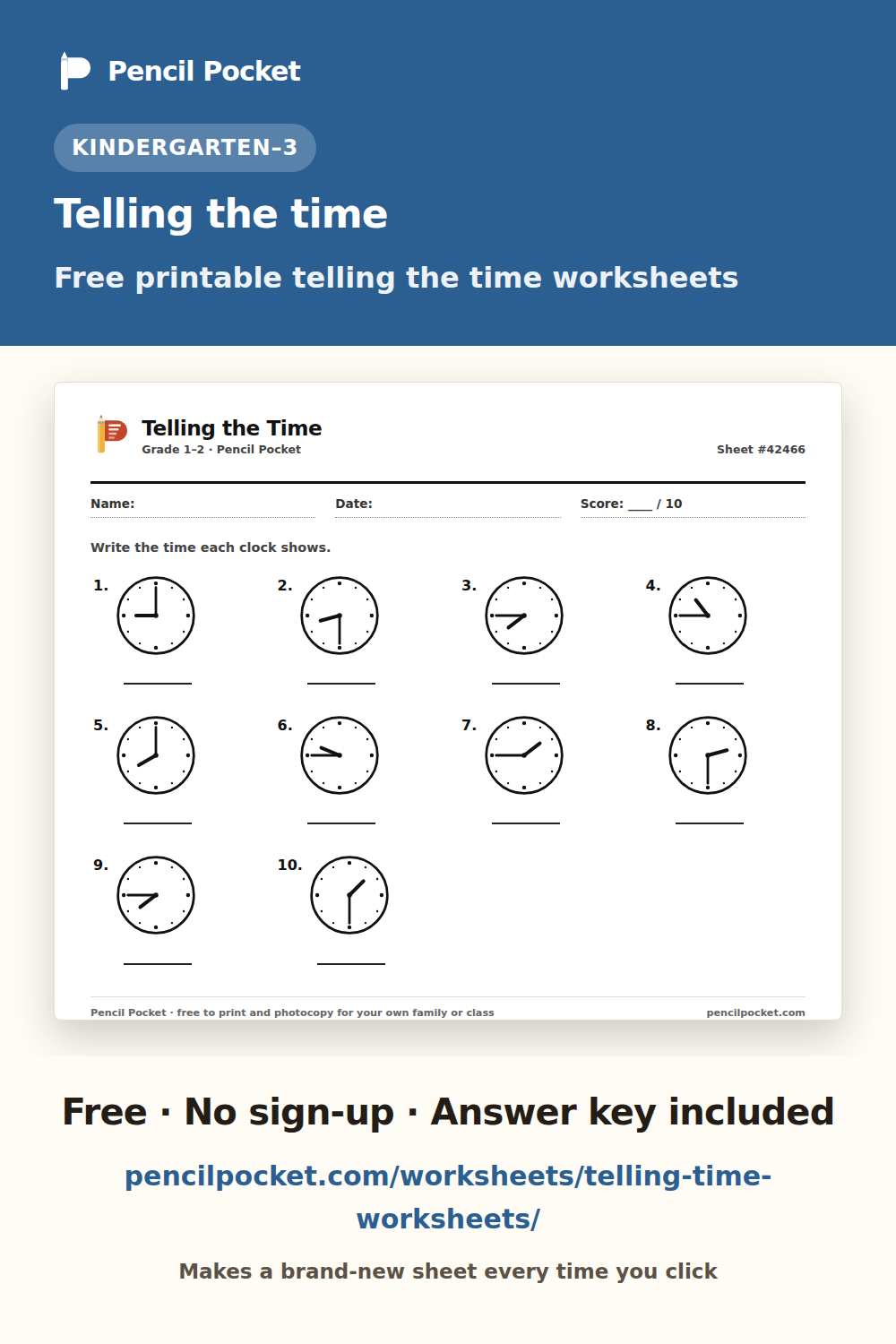
Real clock faces to read, then elapsed-time problems once reading a clock is easy.
KindergartenGrade 1Grade 2Grade 3
Ready to print
Make a telling the time worksheet
Change anything and a new sheet appears immediately, answer key included. Every sheet is different, so two children never get the same page.
About telling the time
Reading an analogue clock is a genuinely hard skill hiding inside an ordinary one. The two hands move at different speeds, mean different things, and are read in different units — and the hour hand is almost never pointing at the hour.
The clocks on these sheets are drawn by the site rather than pulled from a picture library, which means the hands are generated from the same numbers as the answer key and cannot disagree with it. Early levels stay on o'clock and half past. Later levels move to elapsed time, which is where most children actually struggle: not reading a clock, but working out how long there is until something.
What actually helps
- Teach the minute hand first and on its own. It is the easier of the two.
- Ask 'is it nearly the next hour, or just past this one?' before asking for the exact time.
- For elapsed time, count on in whole hours first, then the minutes.
Common questions
Does analogue time still matter?
For understanding it does. A clock face is the first place most children meet a circular scale, fractions of an hour, and counting in fives — all of which are used far beyond telling the time.
What age should a child read a clock?
O'clock and half past around age five or six, quarter past and quarter to around seven, and five-minute intervals by about eight. Elapsed time is usually Grade 3 or 4.
Thank you — that genuinely helps.
Save this for later
Pin it and it will be waiting the next time you need ten minutes of telling the time practice. The page makes a fresh sheet every visit, so a saved pin never goes stale.
Next
Related worksheets
-
Math unlimited
Greater than, less than, equal to
The <, > and = symbols, with equals cases mixed in so it stays a real question.
-
Math unlimited
Math word problems
Ten problems in plain language, mixing all four operations so the child has to choose.
-
Math unlimited
Skip counting
Fill in the missing numbers in a counting pattern. The quiet groundwork for times tables.