Multiplication tables worksheets
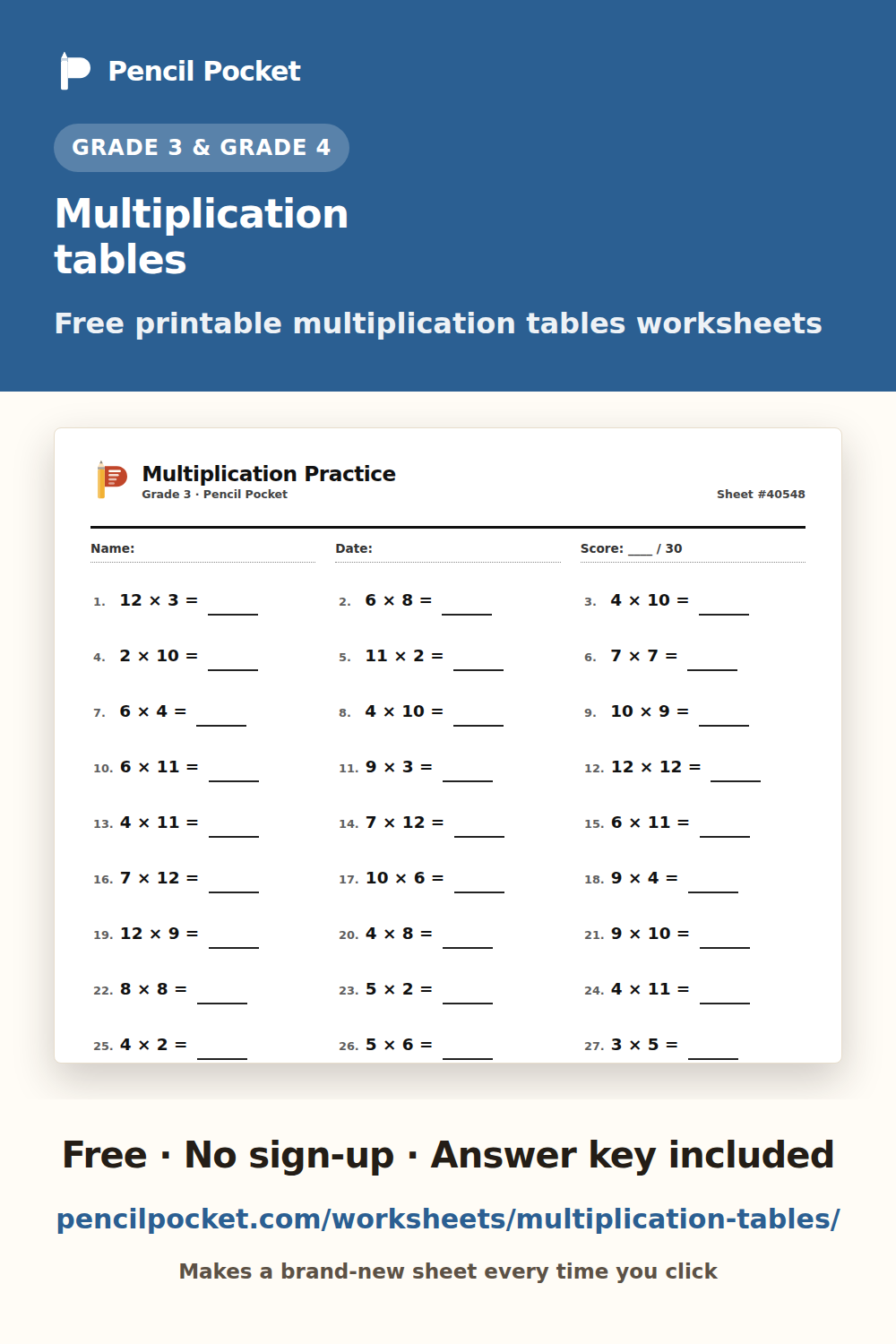
Times tables to 12 × 12, mixed and endless. The single highest-leverage drill in primary maths.
Ready to print
Make a multiplication tables worksheet
Change anything and a new sheet appears immediately, answer key included. Every sheet is different, so two children never get the same page.
About multiplication tables
If there is one thing worth becoming automatic before secondary school, it is the multiplication tables. Almost everything after Grade 4 — fractions, division, area, ratio, algebra — runs slower for a child who has to work out 7 × 8 each time.
Automatic means answering without calculating. That takes spaced repetition over months, not a heroic weekend. Three minutes a day beats an hour a week, reliably.
What actually helps
- Learn them in this order: 2, 5, 10, then 3, 4, then 6, 7, 8, 9, then 11, 12.
- There are only a handful of genuinely hard ones. 6×7, 7×8, 8×9 — target those.
- Mixed pages beat single-table pages once each table is known, because they test recall rather than pattern.
Common questions
What age should a child know their times tables?
In most curricula the expectation is fluency to 10 × 10 or 12 × 12 by the end of Grade 4. Plenty of children get there later and are entirely fine.
What is the fastest way to learn times tables?
Short daily recall practice with immediate feedback, mixing tables together once each is known individually. Long sessions produce familiarity, not recall.
Thank you — that genuinely helps.
Save this for later
Pin it and it will be waiting the next time you need ten minutes of multiplication tables practice. The page makes a fresh sheet every visit, so a saved pin never goes stale.
Next
Related worksheets
-
Math unlimited
Division facts
Exact division with no remainders, built from the times tables a child already knows.
-
Math unlimited
Rounding to the nearest 10 and 100
Rounding practice that mixes tens and hundreds, so it can't be done on autopilot.
-
Math unlimited
Math word problems
Ten problems in plain language, mixing all four operations so the child has to choose.