Letter tracing worksheets
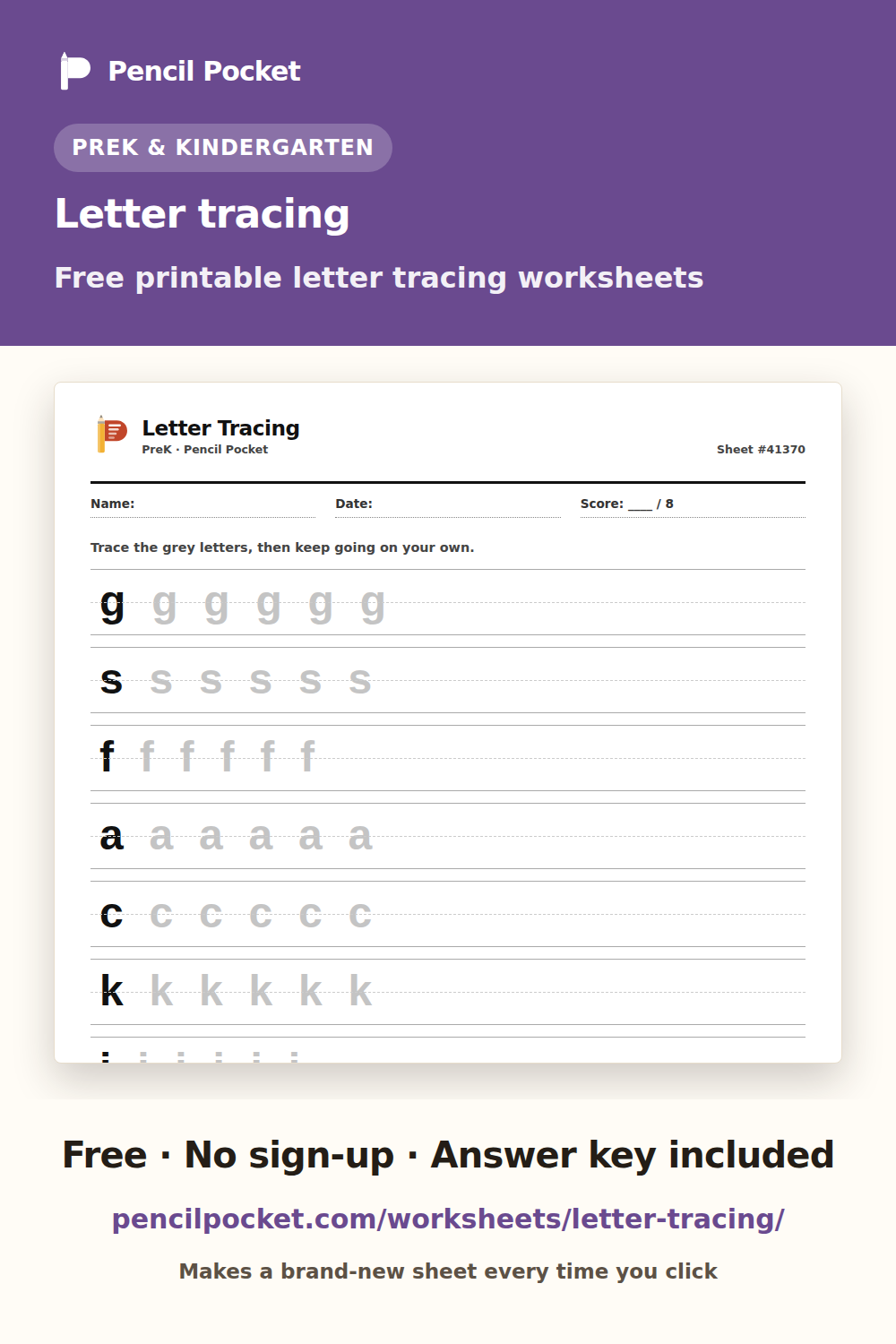
Dotted lowercase letters on three ruled lines, with a solid model to copy from.
Ready to print
Make a letter tracing worksheet
Change anything and a new sheet appears immediately, answer key included. Every sheet is different, so two children never get the same page.
About letter tracing
Letter formation is a motor skill before it is a literacy one. A child who forms letters from the wrong starting point will write more slowly for years, and it is far easier to establish the habit than to correct it later.
Lowercase first. Most text is lowercase, and the letters are easier to form. Capitals can wait until lowercase is comfortable.
What actually helps
- Watch where the pencil starts, not just how the letter ends up.
- Short and frequent. Small hands tire fast; five minutes is a full session.
- Standing at a wall or an easel is easier for some children than sitting at a table.
Common questions
Should children learn capital or lowercase letters first?
Lowercase, in most approaches. It makes up the large majority of written text and the letter shapes are generally simpler to form.
At what age should a child be able to write their name?
Many children manage it around age 4 or 5, but the range is very wide and later is not a warning sign on its own.
Thank you — that genuinely helps.
Save this for later
Pin it and it will be waiting the next time you need ten minutes of letter tracing practice. The page makes a fresh sheet every visit, so a saved pin never goes stale.
Next
Related worksheets
-
Writing unlimited
Handwriting practice
Ruled practice lines with a fading model, for children past the tracing stage.
-
Reading unlimited
Kindergarten sight words
High-frequency words with a word bank, a model to trace, and space to write.