Place value worksheets
Which digit sits where, what it is worth, and writing a number in expanded form.
Ready to print
Make a place value worksheet
Change anything and a new sheet appears immediately, answer key included. Every sheet is different, so two children never get the same page.
About place value
Place value is the single most important idea in primary arithmetic and the one most often skimmed. Almost every persistent problem with column addition, borrowing, decimals or long division turns out, when you dig, to be a place value problem wearing a disguise.
The three question shapes here attack it from different sides: naming the digit in a place, giving the value of a digit, and writing a number in expanded form. The second is the one that matters most — a child who can tell you the 7 in 4,738 is worth 700, not 7, has understood the thing.
What actually helps
- Read big numbers aloud in full. 'Four thousand, seven hundred and thirty-eight' is a place value lesson.
- Ask what would happen to the number if that digit were a 9 instead.
- Expanded form is worth doing slowly. It is the bridge to column arithmetic.
Common questions
Why does my child write 'four hundred and seven' as 4007?
Because they are writing what they hear, one chunk at a time, which is a completely logical thing to do. It is the classic sign that place value needs work, and it usually clears up quickly with expanded form practice.
Is expanded form actually useful?
Yes — it is how column addition and subtraction work underneath. A child who understands 500 + 40 + 3 rarely gets confused about which column to carry into.
Thank you — that genuinely helps.
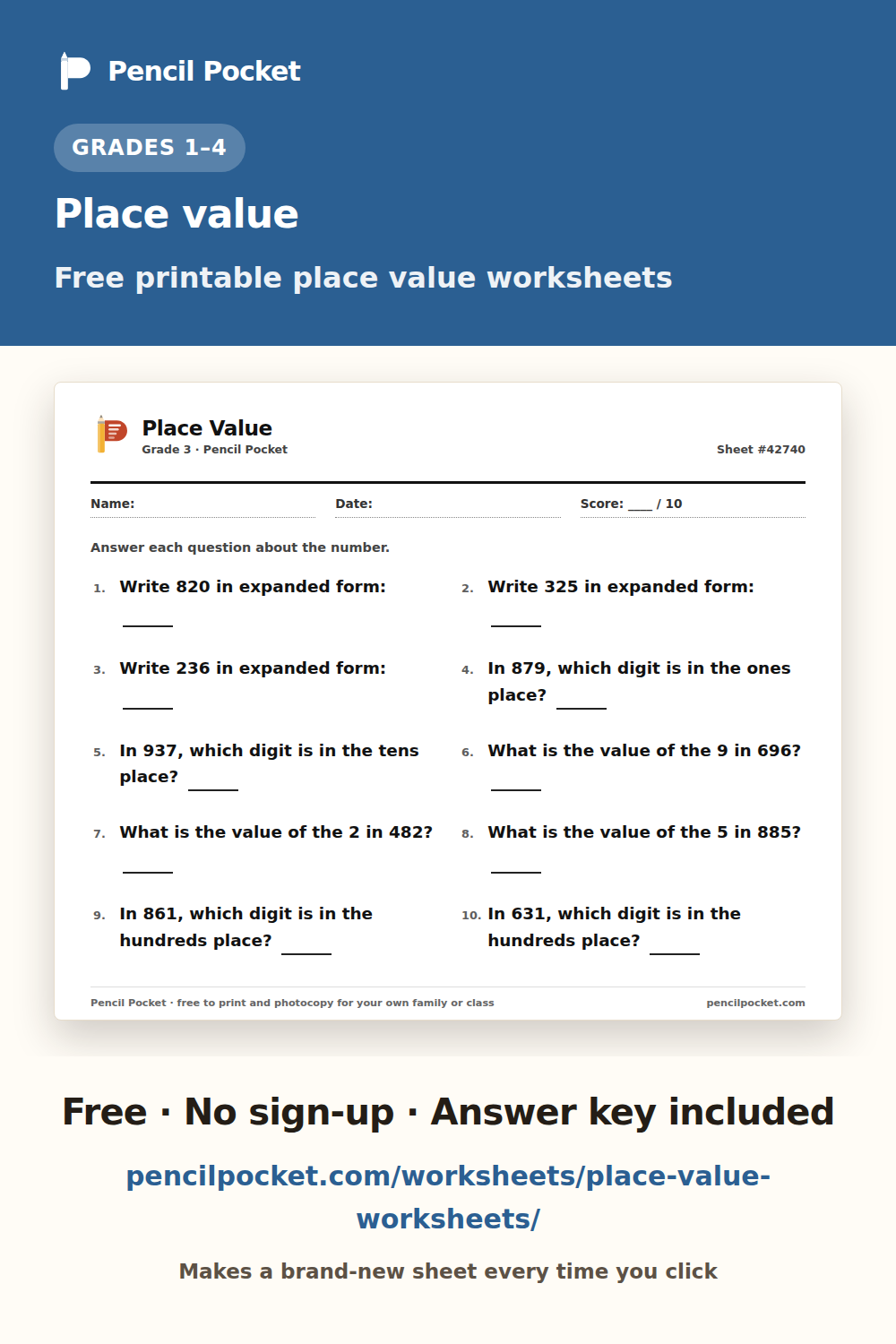
Save this for later
Pin it and it will be waiting the next time you need ten minutes of place value practice. The page makes a fresh sheet every visit, so a saved pin never goes stale.
Next
Related worksheets
-
Math unlimited
2-digit addition with regrouping
Carrying, borrowing, and the moment place value stops being theoretical.
-
Math unlimited
Greater than, less than, equal to
The <, > and = symbols, with equals cases mixed in so it stays a real question.
-
Math unlimited
Rounding to the nearest 10 and 100
Rounding practice that mixes tens and hundreds, so it can't be done on autopilot.