Skip counting worksheets
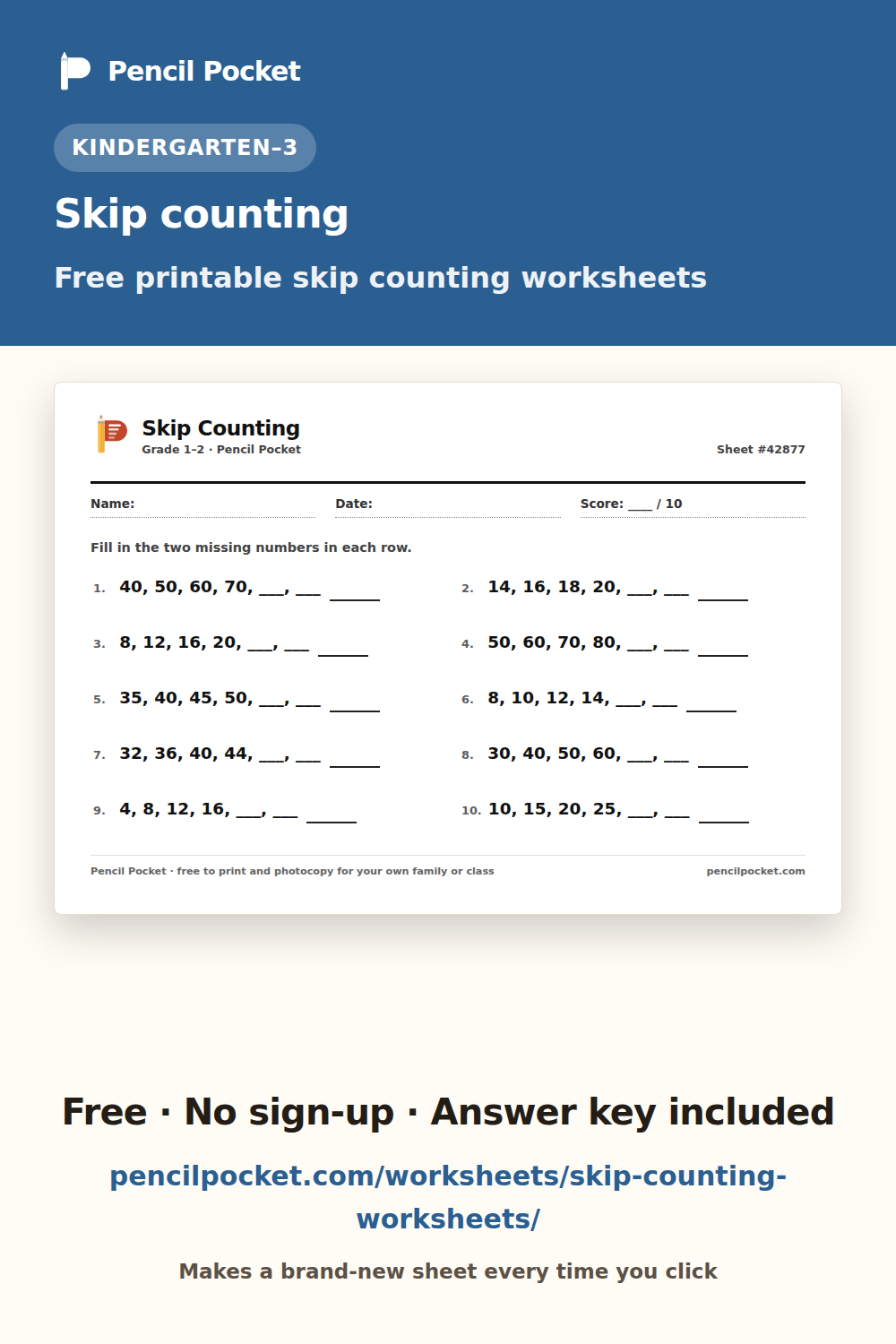
Fill in the missing numbers in a counting pattern. The quiet groundwork for times tables.
KindergartenGrade 1Grade 2Grade 3
Ready to print
Make a skip counting worksheet
Change anything and a new sheet appears immediately, answer key included. Every sheet is different, so two children never get the same page.
About skip counting
Skip counting looks like the easiest thing on this site and is doing more work than almost anything else on it. Counting in fours is multiplication before a child has met multiplication, and a child who can count in sixes without hesitating has, in effect, already learned most of the six times table.
Later levels count backwards as well, which is much harder and much more useful. Backwards counting is the foundation of subtraction and of division, and it is the part most practice skips entirely.
What actually helps
- Chant it aloud before writing it. The rhythm is doing the memorising.
- Start from somewhere other than zero sometimes — 7, 14, 21 is easy; 23, 30, 37 is not.
- When a table is not sticking, go back to skip counting it rather than drilling facts.
Common questions
How is this different from times tables practice?
Times tables ask for a fact out of order and at random. Skip counting builds the sequence first, which is how most children get to the facts. Doing it in this order is usually faster than drilling.
Which steps matter most?
Twos, fives and tens first, then threes and fours. Sixes, sevens and eights are the ones children find hardest and the ones this practice helps most.
Thank you — that genuinely helps.
Save this for later
Pin it and it will be waiting the next time you need ten minutes of skip counting practice. The page makes a fresh sheet every visit, so a saved pin never goes stale.
Next
Related worksheets
-
Math unlimited
Multiplication tables
Times tables to 12 × 12, mixed and endless. The single highest-leverage drill in primary maths.
-
Math unlimited
Missing number problems
7 + ___ = 12. Quietly the first algebra a child ever does.
-
Math unlimited
Telling the time
Real clock faces to read, then elapsed-time problems once reading a clock is easy.