Money worksheets
Counting mixed coins, then working out change. Every total works out exactly.
Ready to print
Make a money worksheet
Change anything and a new sheet appears immediately, answer key included. Every sheet is different, so two children never get the same page.
About money
Money is the most useful arithmetic a child does, because it is the only kind they will definitely still be doing at forty. It is also unusually good practice: counting mixed coins is addition with unequal units, and working out change is subtraction with a real reason attached.
Early sheets combine two different coins, which is the point of the exercise — adding three quarters to four more quarters teaches nothing that multiplication does not. Later sheets move to change from a note, which is where the subtraction actually bites.
What actually helps
- Use real coins alongside the sheet for the first few goes.
- Count on to find change rather than subtracting. It is how shopkeepers do it and it is easier.
- Say the total aloud in two ways: '95 cents' and 'five cents less than a dollar'.
Common questions
Do children still need this if everything is contactless?
Arguably more. A child who never sees cash has no physical model of what a number of dollars means, and money problems are one of the few places arithmetic comes with an obvious purpose attached.
Should I use my own country's coins?
These sheets use cents, nickels, dimes and quarters. The skill transfers directly — if your coins differ, work through the first sheet swapping the names aloud.
Thank you — that genuinely helps.
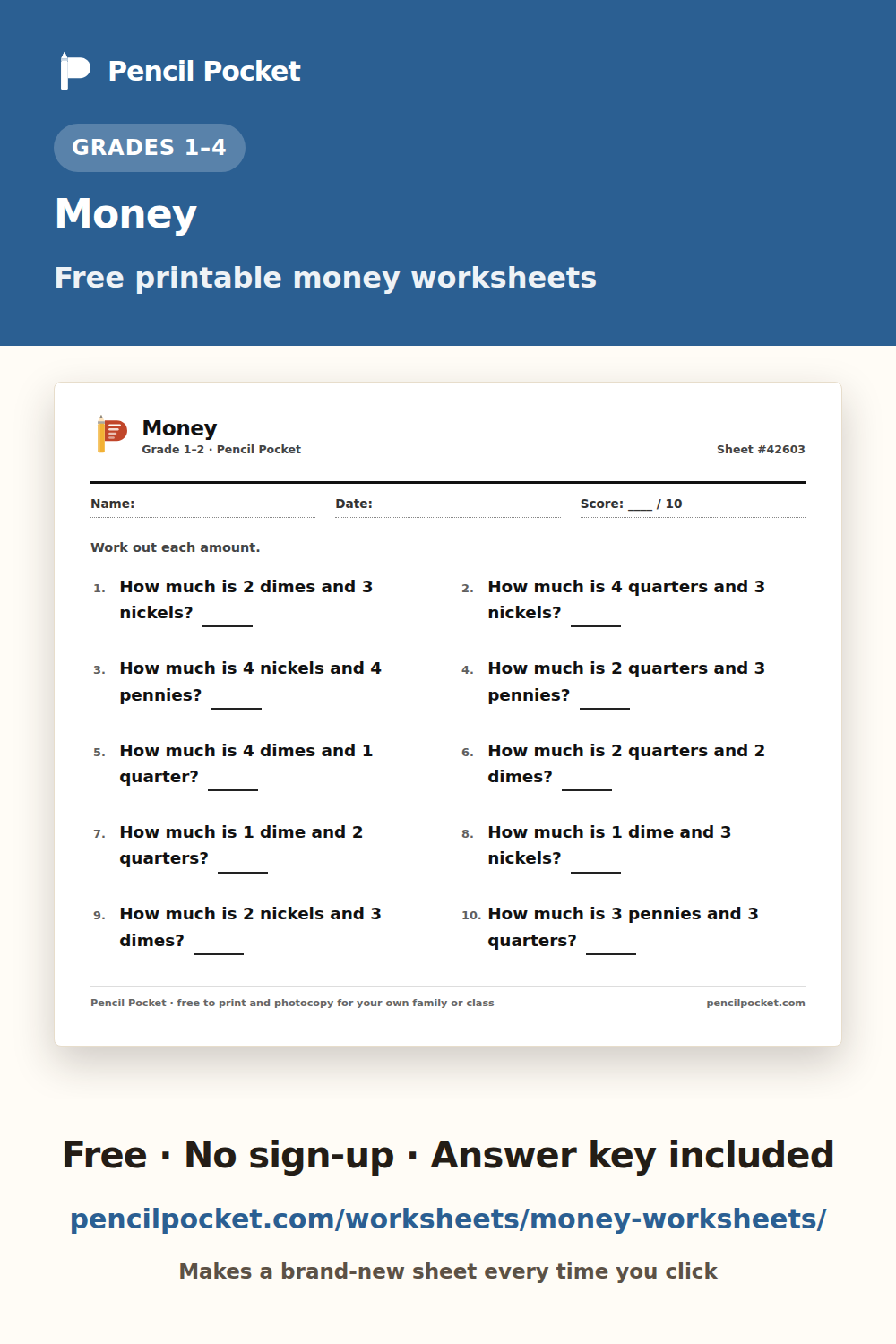
Save this for later
Pin it and it will be waiting the next time you need ten minutes of money practice. The page makes a fresh sheet every visit, so a saved pin never goes stale.
Next
Related worksheets
-
Math unlimited
Subtraction within 20
Take-away and difference, with answers that never go below zero.
-
Math unlimited
Math word problems
Ten problems in plain language, mixing all four operations so the child has to choose.
-
Math unlimited
Place value
Which digit sits where, what it is worth, and writing a number in expanded form.